height="1" width="1" src="https://www.facebook.com/tr?id=974289589738309&ev=PageView &noscript=1"/
Plantar Fasciitis & Heel Spur Treatment in Calgary

Plantar Fasciitis & Heel Spur Treatment Calgary – Osteo Health

Gentle. Effective. Clinically proven. Designed to relieve pain and restore pain-free movement.

If your heels hurt when you wake up, if every step feels stabbing or burning, or if walking and standing interferes with your life — our expert team can help.
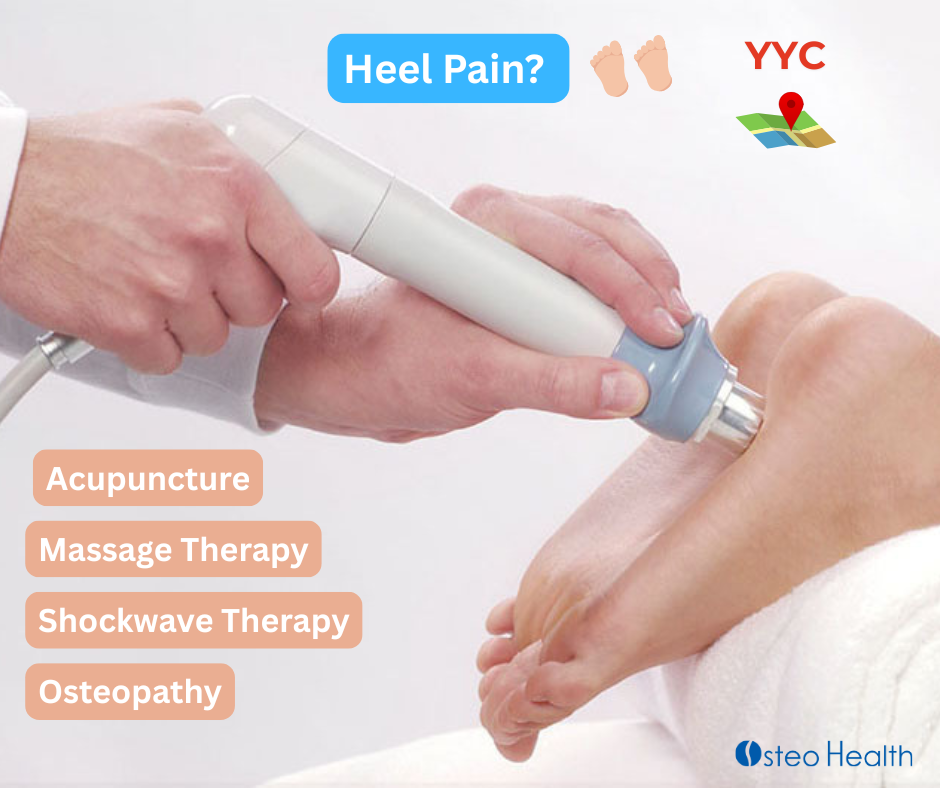
At Osteo Health Calgary, we have available Osteopathy, Massage, Acupuncture and Shockwave Therapy to treat both the symptoms and the root causes of your foot pain.

What Is Plantar Fasciitis & Heel Spur Pain?

Plantar fasciitis is an inflammation of the thick band of tissue (plantar fascia) that runs across the bottom of your foot.
Heel spurs are small calcium deposits on the heel bone that often form due to chronic tension in the plantar fascia.

These conditions commonly cause:

  • Sharp heel pain with the first steps in the morning

  • Pain that gets worse after prolonged standing or walking

  • Burning or tenderness in the arch and heel

  • Difficulty with everyday activities

This pain can make even simple movements feel impossible.

Why Our Treatment Works Better

We use a multi-modal approach that accelerates healing, calms pain, and restores proper foot mechanics:

TreatmentFocus & Benefits
💥 Shockwave Therapy                         A clinically validated, non-invasive treatment that:
✔ Breaks down scar tissue
✔ Reduces chronic inflammation
✔ Increases local blood flow
✔ Stimulates tissue repair
👐 Massage Therapy                                                          Focused on muscles, tendons, calves, and the plantar fascia itself to:
✔ Release tight tissue
✔ Improve circulation
✔ Reduce tension and pain
✔ Prepare the foot for shockwave work
👐 Osteopathy                   Focused on the structure to:
✔ Release soft tissue
✔ Improve range of motion (ROM)
✔ Reduce tension and pain
🪡 Acupuncture                                               Our plantar fasciitis acupuncture treatments focus on:
✔ Reducing pain and inflammation
✔ Improving circulation
✔ Releasing muscle and fascia tension
✔ Supporting tissue recovery
✔ Improving foot mobility

Together, these therapies deliver results that last — not just temporary pain relief.

What to Expect From Your Program

We recommend a structured series of minimum 4-6 weekly treatments for predictable and lasting improvement.

Clients typically experience:

✔ Reduced pain after 1–2 sessions
✔ Increased mobility
✔ Easier walking & standing
✔ Stronger tissue and fewer flare-ups

Your practitioner will tailor the exact plan to your symptoms and goals.

Plantar Fasciitis Treatment Plan

WeekRecommended TreatmentGoal
Week 1Osteopathy or Massage Therapy + Acupuncture + Shockwave Therapy (included at no extra cost)Reduce acute tension, improve mobility, begin tissue stimulation
Week 2Acupuncture + Osteopathy or Massage Therapy + ShockwaveReduce inflammation and pain while continuing soft tissue work
Week 3Osteopathy or Massage Therapy + Acupuncture + ShockwaveImprove calf, fascia, and foot mobility
Week 4Acupuncture + Osteopathy or Massage Therapy + ShockwaveSupport healing and circulation
Week 5 (if needed)Combination treatment based on progressContinue tissue recovery and functional improvement
Week 6 (if needed)Combination treatment based on progressStabilization and maintenance planning

Suggested Insurance-Friendly Approach

Phase 1 — Intensive Recovery (4–6 Weekly Treatments)

If insurance allows, many clients choose:

  • Weekly Osteopathy or Massage Therapy
  • combined with Acupuncture
  • plus Shockwave Therapy included at no extra cost

This phase focuses on:
✔ pain reduction
✔ inflammation management
✔ tissue healing
✔ restoring mobility
✔ reducing chronic tension patterns


Phase 2 — Maintenance & Prevention

Once symptoms improve, many clients continue with:

  • maintenance Massage Therapy or Osteopathy
  • periodic Shockwave Therapy (included with treatment)
  • home stretching and strengthening exercises

This helps:
✔ maintain mobility
✔ reduce flare-ups
✔ support long-term recovery
✔ prevent recurrence


Important Note

Every case is different. Some clients improve quickly, while chronic or long-standing plantar fasciitis may require a longer recovery plan depending on:

  • activity level
  • footwear
  • work demands
  • biomechanics
  • duration of symptoms
  • calf and fascia tightness

Consistency is often one of the biggest factors in successful recovery.

Why Choose Osteo Health Calgary?

⭐⭐⭐⭐⭐ Google rating | In practice since 2018

  • Experienced manual Osteopaths, Acupuncturists and Massage Therapists trained in foot biomechanics

  • Personalized treatment plans — not cookie-cutter care

  • Calm, supportive clinic environment

  • Direct online booking 24/7

  • Covered under most insurer plans

📍 Conveniently Located in South Calgary.

Osteo Health proudly serves:
Midnapore, Shawnessy, Somerset, Evergreen, Millrise, Bridlewood, Canyon Meadows, Sundance, Walden, Legacy, Seton, Cranston, Auburn Bay, Mahogany, McKenzie Towne, Shawnee Slopes and surrounding Calgary communities.

Transparent Pricing | Expert hands‑on treatment

💡FAQ — Plantar Fasciitis & Heel Spur Treatment

What causes plantar fasciitis and heel spurs?

Plantar fasciitis is usually caused by repetitive stress on the plantar fascia — the thick ligament that supports your arch.
This stress can come from:

  • Long hours of standing

  • Walking on hard floors

  • Flat feet or high arches

  • Tight calves or Achilles tendon

  • Poor footwear

  • Overuse (walking/running)

Heel spurs often form when plantar fasciitis becomes chronic.


How many treatments do I need?

Our structured program includes minimum 4-6 weekly treatments.
Most clients notice improvement after their first or second session, with full results by week 4.


Does shockwave therapy hurt?

Shockwave therapy may create a mild tapping sensation, but it is well tolerated.
Most clients describe it as intense but manageable, and the discomfort decreases as the tissue heals.


What happens during the appointment?

✔ Assessment of your foot, ankle, and lower body mechanics
✔ Osteopathic manual therapy or Acupuncture or Therapeutic massage to calves, Achilles, and plantar fascia
✔ Shockwave therapy application
✔ Home-care instructions to support healing


Is the treatment covered by insurance?

Treatments are billed under:

  • Massage Therapy 
  • Osteopathy 
  • Acupuncture

Shockwave therapy is included at no extra cost with Massage and Osteopathy.

We recommend checking your plan for coverage details.


Can plantar fasciitis heal on its own?

Sometimes mild cases improve with rest, but most chronic cases require treatment.
Without proper care, pain can last months — sometimes years — and may develop into a persistent heel spur.


Is this treatment safe for seniors?

It depends on your health condition. We always tailor our protocol for seniors.
We treat many seniors experiencing chronic heel and arch pain, and the multi-modal approach (osteopathy + massage + shockwave and other) is gentle, safe, and highly effective.


What results can I expect?

Most people experience:
✔ Less pain in the morning
✔ Improved walking and standing
✔ Reduced inflammation
✔ Better mobility
✔ Less reliance on pain medications

With consistency, results continue to improve even after treatment ends.


What should I wear to the appointment?

Loose pants or leggings that can be rolled above the calf.
We need access to the foot, ankle, and lower leg.


When should I NOT receive shockwave therapy?

Shockwave may not be suitable if you have:

  • Blood clotting disorders

  • Active infection

  • Open wounds

  • Recent steroid injection in the area

  • Pregnancy (depending on location, we assess case by case)

  • Cardiac pacemaker
  • Osteoporosis and other

Your practitioner will review all contraindications at your first visit.


Do I need orthotics?

Some clients benefit from supportive footwear or insoles, but we first aim to:

  • Reduce inflammation

  • Improve foot mechanics

  • Address tightness and muscle imbalance

Can I continue walking or exercising?

Yes — but avoid high-impact activity (like running) until pain decreases.
Walking, gym workouts, and movement are generally safe, and we will guide you on what to modify or avoid.

🦶 Ready to Walk Pain-Free Again?

✨ Don’t let heel pain slow your life down!!!

📅 Choose Your Treatment, Your Practitioner and Book Online!

🏃‍♂️ Limited  new‑patient slots per week to ensure personalised care.